Key Takeaways
- Myopia and astigmatism are both refractive errors linked to the shape of your eye.
- Myopia blurs distant objects, while astigmatism can blur vision at any distance.
- Glasses, contact lenses, and laser options can each help correct these conditions.
- You can have both at the same time, and one prescription can address both.
- Regular exams help catch changes early and keep your vision comfortable.
Blurry vision has a way of sneaking up on you. Maybe road signs look fuzzy from the driver’s seat, or the words on a page seem to carry a faint shadow. Myopia and astigmatism are two common reasons behind that blur, and they’re easy to mix up. Our team at Collingwood Optometry & Cwood Eyecare helps people sort out the difference every day.
Myopia and astigmatism are both refractive errors, but myopia blurs distant objects because the eye is slightly too long, while astigmatism can blur vision at any distance because of an uneven curve. Both are common, and our team in Collingwood can tell you which one, or both, is behind your blur.
What Refractive Errors Mean for Your Vision
Your eyes work a bit like a camera. Light enters through the front and lands on the back of the eye, where it forms the picture you see. When that light lands exactly where it should, things look sharp.
The shape of your eye decides where that light falls. If the eye is a little too long or the front surface curves unevenly, the light misses its mark, and your view goes soft or blurry. Both myopia and astigmatism happen this way, which is why they get grouped together as refractive errors.
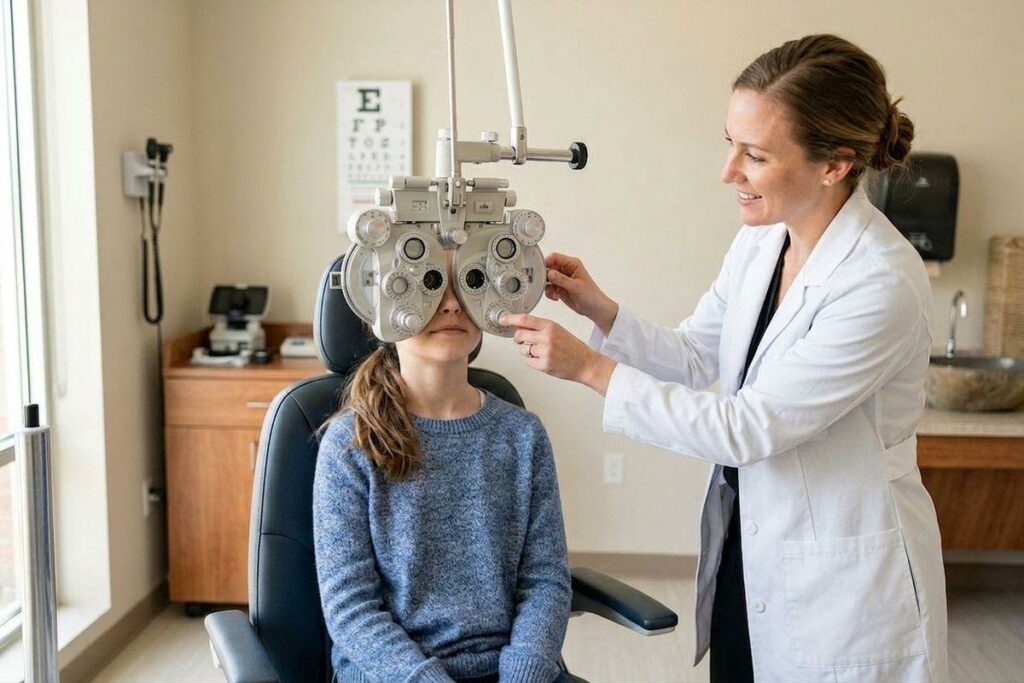
A full eye exam is how these get spotted. Our team in Collingwood can measure how your eyes bend light and tell you exactly what’s going on.
Myopia Explained
How Myopia Affects Your Sight
Myopia, often called nearsightedness, usually shows up when the eyeball grows a little longer than average or the cornea curves too steeply. Light then focuses just short of where it should.
The result feels familiar to a lot of people. A book in your hands typically stays crisp, but a road sign down the block turns fuzzy. Near vision holds up while distance vision slips.
Signs to Watch For
Myopia can creep in slowly, especially in kids. Watch for these clues:
- Squinting to make out faraway objects
- Eyestrain or headaches after focusing across a room
- Prescriptions that keep changing over short stretches
Astigmatism Explained
How Astigmatism Affects Your Sight
Astigmatism comes from an uneven curve in the cornea or the lens inside your eye. Instead of a smooth, round shape like a basketball, the surface looks more like the back of a spoon.
That uneven shape scatters light in more than one spot. So vision can blur whether something sits close or far away. Minor cases often slip by unnoticed for years.
Signs to Watch For
The signs can be subtle, but a few tend to stand out:
- Blurred or shadowed vision, almost like a faint double image
- Trouble with glare and halos while driving at night
- Eye irritation and squinting as your eyes try to sharpen the picture
Does Astigmatism Mean Poor Eyesight?
Not on its own. Astigmatism ranges from so slight you’d never know to strong enough to affect daily tasks, and it shifts from person to person.
Correction helps bring things back into focus. With the right lenses, most people see clearly and comfortably again.

Key Differences and When Both Conditions Overlap
Shape, Vision, and Severity Compared
The quickest way to tell them apart comes down to what blurs. Myopia softens your distance vision, while near vision typically stays sharp. Astigmatism can blur things at every distance.
They also need different lens corrections. Myopia uses a lens that pulls focus back to the right spot, while astigmatism needs a lens shaped to even out that uneven curve. Both can be mild or more noticeable.
When You Have Both
Plenty of people have both conditions at once. That’s completely normal, but it doesn’t mean it will be harder to manage.
A single prescription can correct for myopia and astigmatism together, whether you wear glasses or contact lenses.
Treatment and Care Options for Clearer Vision
Glasses, Contacts, and Surgery
Glasses are a simple, reliable place to start, and toric contact lenses are made to handle the uneven curve of astigmatism. Both can sharpen your view day to day.
Laser options such as LASIK and PRK reshape the cornea and suit some adults. For kids whose eyes are still growing, myopia control methods can help slow how quickly the prescription changes.
Daily Habits That Support Your Eyes
Small routines add up. Try these:
- Take short breaks from screens to rest your focus
- Spend time outdoors in daylight, which helps growing eyes.
- Book regular exams with the eye doctors in Pennsylvania
These habits won’t replace lenses, but they help keep your eyes comfortable between visits.
We Can Help
Whether you’re squinting at road signs or dealing with blur up close, our team at Collingwood Optometry & Cwood Eyecare can help you find out what’s behind it and how to correct it. Book an eye exam today and take the first step toward clearer, more comfortable vision.